The Battle of the Kalka (1223): Harbinger of the Mongol Storm
When Jebe and Subutai's reconnaissance army crossed the Caucasus and descended onto the steppe, the Kipchaks and the Rus fought side by side for the first time, and lost.
- Added by
- Emre Emir
- On this site
- · 2 min read · 3 reads
This text is a translation of the Turkish original. Read the Turkish original
In the early 1220s two of Genghis Khan's master commanders, Jebe and Subutai, set out westward on a great reconnaissance expedition after the Khwarazm campaign. They passed through Iran and Azerbaijan, defeated the Georgian army, and then crossed the Caucasus mountains and descended into the North Caucasus.
The Alans and the Kipchaks
In the North Caucasus the Mongols were met by an alliance of Alans and Kipchaks. According to the sources, the Mongols detached the Kipchaks from the alliance by reminding them that they were "of the same stock" and by promising them booty. After the Alans were defeated, the Mongols then attacked the Kipchaks, who were now on their own.
Köten's appeal
Köten, one of the leading Kipchak khans, turned to his son-in-law Mstislav, Prince of Galicia. As the Rus chronicles relate, Köten asked for help, saying: "Today they have taken our land; tomorrow they will take yours." The Rus princes gathered in Kiev and decided to march into the steppe.
31 May 1223
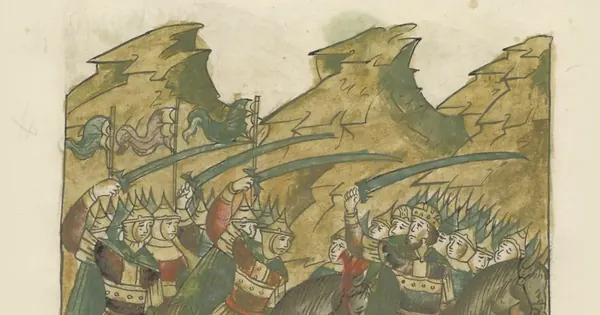
The combined Rus-Kipchak army met the Mongols on the banks of the Kalka river, which flows into the Sea of Azov in what is today south-eastern Ukraine. For several days the Mongols retreated, drawing the enemy after them; this was a well-known tactic of steppe warfare. There was no coordination among the Rus princes; some attacked without waiting for the others.
In the battle the Kipchak units broke first and, as they fell back, also scattered the Rus ranks. This detail led later Rus chronicles to place the blame for the defeat on the Kipchaks. In fact the disunity of the Rus princes was just as decisive: some of them had attacked without waiting for the others. Mstislav Romanovich, Prince of Kiev, held out in the fortified camp he had built; after surrendering he was killed.
A brief respite
After the Kalka the Mongols turned back east and disappeared for a while. Life on the steppe seemed to return to its old order. But this had only been a reconnaissance. Thirteen years later, in 1236, a much larger army returned under the leadership of Batu Khan.
The fall of the Dasht-i Kipchak
Batu's campaign of 1236–1241 put an end to the political independence of the Kipchak tribes. Leaders such as Bachman, who resisted in the Volga basin, were captured and killed. Some Kipchaks migrated to Hungary, others to the Balkans and the Caucasus. Those who remained on the steppe formed the population of the Ulus of Jochi, that is, the Golden Horde.
Interestingly, this conquest did not destroy Kipchak identity. The numerically small Mongol ruling class gradually adopted the Kipchak language and culture. The language of the Golden Horde became largely Kipchak; this process played a decisive role in the formation of today's Tatar, Kazakh and Nogai peoples.
Bibliography
- Novgorod Birinci Yıllığı, 1224 kaydı.
- İbnü'l-Esîr. el-Kâmil fi't-Târîh, 620 H. yılı olayları.
- May, T. The Mongol Conquests in World History. Londra, 2012.
- Jackson, P. The Mongols and the West, 1221–1410. Harlow, 2005.
Mentioned in this publication
Explore on the live mapCite this publication
Kıpçaklar Yayın Kurulu. (2026). The Battle of the Kalka (1223): Harbinger of the Mongol Storm. Kıpçaklar. https://kipcaktarihi.com/en/yazi/battle-of-the-kalka-1223-kipchaks-rus-and-the-mongols
Kıpçaklar Yayın Kurulu. “The Battle of the Kalka (1223): Harbinger of the Mongol Storm.” Kıpçaklar, 2026. https://kipcaktarihi.com/en/yazi/battle-of-the-kalka-1223-kipchaks-rus-and-the-mongols.
Kıpçaklar Yayın Kurulu. “The Battle of the Kalka (1223): Harbinger of the Mongol Storm.” Kıpçaklar, 2026, https://kipcaktarihi.com/en/yazi/battle-of-the-kalka-1223-kipchaks-rus-and-the-mongols.
Contribute to this publication
Have you spotted an error, or do you have information or a source to add? Send an update suggestion based on your own knowledge and sources. No account is needed; suggestions are reviewed by the author and the editorial board.
Want to edit the text directly? Log in with your account and edit in the panel or create a free account. Your changes are reviewed side by side; if accepted, your name will appear among the contributors.


