Oltu and Its Surroundings: The History of a Kipchak Homeland
A fortress town from the Saltukids to the Atabeg Yurt, from Ottoman to Russian rule and the Republic
Oltu, north of Erzurum, is a Kipchak homeland: after the Saltukid conquest the Kipchaks settled here in 1124, and the town served as the centre of the Atabeg Yurt's principality of Tao. The long history of the fortress town, with its sources.
- On this site
- · 7 min read · 4 reads
This text is a translation of the Turkish original. Read the Turkish original
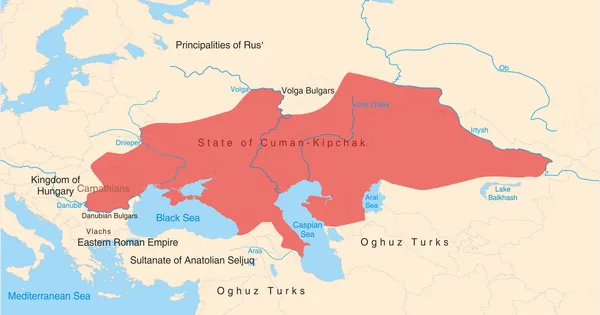
The castle rising in the valley carved by the Oltu stream, north-east of Erzurum, controlled for centuries the junction of routes linking Eastern Anatolia to the Black Sea via the Çoruh valley and to the Caucasus via the Kura basin. Appearing in historical sources in forms such as Oltik, Oltisi or Okhtik, Oltu was, because of this strategic position, an important frontier fortress under each of the Byzantine, Georgian, Saltukid, Atabeg, Ottoman and Russian administrations.1 Oltu is also a Kipchak homeland: the Georgian chronicles record that in 1124 the Kipchaks settled in Oltu with their families, and the town became one of the centres of the Upper Çoruh basin, which witnessed dense Kipchak settlement after the twelfth century.

The origin of the name: local tradition and documents
Local history compilations and popular tradition hold that the name Oltu derives from a Kipchak tribe or clan, and that the same name was also given to a town and a village in the Lesser Shirvan region in southern Daghestan. The name of the settlement also occurs in Armenian and Georgian sources predating the twelfth century, when the Kipchaks arrived in the region. The main evidence that Oltu was a Kipchak homeland lies not in the name but in the settlement records set out below: the Georgian chronicles, the works of Kırzıoğlu, Özmenli, Kıldıroğlu and Ersin Hakan, and the TDV Encyclopaedia of Islam.
Kırzıoğlu writes that the name Tavasker (Taoskari), north of Oltu, is a remnant of the Taochi, the ancient people of the region. Throughout the Middle Ages Oltu was considered part of the region the Georgians called Tao.2
The Saltukid conquest and the settlement of 1124
When the Saltukid Beylik centred on Erzurum was founded after Manzikert, Oltu too became a target of Turkish raids. According to Kırzıoğlu, Emir Ahmed, sent to the region by Sultan Malikshah in 1080, took the Erzurum and Oltu areas, after Kars, from the Byzantine commander Gregory son of Bagur.3 Local compilations also give 1080 as the year in which Oltu passed into Turkish hands.
In Kırzıoğlu's account this conquest was the outcome of a series of clashes: Emir Ahmed, joining forces with the Shaddadids, inflicted a heavy defeat on the army of the Georgian king George II at the foot of Mount Arsiyan between Poskov and Şavşat, near the village of Kovel (today Kol), and then took Kars, Erzurum and Oltu. Kırzıoğlu writes that in the same years tribal chiefs named Abu Yaqub and Isa Börü, coming from Turkestan, settled in the Upper Kura and Çoruh valleys at Emir Ahmed's encouragement, so that the lands stretching from Ardanuç to the Black Sea were made home by Muslim Turkic clans.4 Kırzıoğlu's details concerning Emir Ahmed's campaign largely agree with studies of Seljuk history based on Armenian and Arabic sources.
This information shows that the places where the Kipchaks settled in 1124 were not an empty landscape: the Georgian chronicles' phrase “driving out the Turkmens” actually describes the displacement of Oghuz-Turkmen clans that had been living in the region for more than forty years. The later ethnic fabric of the Oltu area was formed from the successive layers of these two Turkic communities.
This dominance was shaken in the face of the army of the Georgian king David IV, strengthened by Kipchak cavalry. According to the Georgian chronicles, in June 1124 the Kipchaks marched to Akhalkalaki and Çıldır, and from there to Göle and İspir, reaching Oltu; when Oltu, İspir and the Çoruh valleys were removed from the emirate of Erzurum, they settled with their families in the places left empty.5 Özmenli, drawing on Kırzıoğlu, likewise shows that after David's death King Demetrius settled the rebellious Cumans in the Ardahan, Oltu, Göle and Tortum areas.6 Together, the Georgian chronicles, Kırzıoğlu and Özmenli show that Oltu became a Kipchak homeland through two successive waves of settlement, one of the frontier homelands of the Christian Kipchaks who settled along the Kura and Çoruh.
A principality centre in the Atabeg Yurt
When the atabegate encompassing the Upper Kura–Çoruh valleys and the Adjara region was established in Ilkhanid times, Oltu too was attached to this polity. When the Atabeg Yurt was divided into five principalities at the end of the fifteenth century, the centre of one of them, the principality of Tao, was first Oltu and later Tortum Akçakale.7 Kıldıroğlu records that members of the Kipchak Chortan (Cordan) tribe also settled around Ardahan, Oltu, Tortum and İspir in the Atabeg period; Oltu's Kipchak population was thus reinforced by a further tribe.8 In this period the region's Christian Kipchak population lived on as a bilingual community attached to the Georgian Church.
The Ottoman age
In 1578, with Lala Mustafa Pasha's campaign, the Atabeg Yurt was annexed to Ottoman territory and the Eyalet of Childir was established. Local sources record that Oltu was for a time the centre of the sanjak of Çıldır. The town, which developed within the castle and its outer walls, retained its importance as a garrison and market town on the Ottoman Caucasus frontier. The TDV Encyclopaedia of Islam presents the Kipchaks around Lake Çıldır as descendants of the Kipchaks who came to Georgia in the twelfth century; it is clear that Oltu too lay within this population geography.9 Most of the region's population embraced Islam between the sixteenth and eighteenth centuries.
Russian rule, the war years and the Republic
The territories ceded to Russia by the Treaty of San Stefano at the end of the Russo-Ottoman War of 1877–1878 were finalised as Kars, Ardahan and Batumi by Article 58 of the Treaty of Berlin; Oltu remained within the Kars Oblast established by the Russians.10 During the forty years of Russian rule new populations were settled in the region and part of the local population emigrated to Ottoman territory.
After the Russian Revolution of 1917, as Russian units withdrew, the administration passed briefly to Armenian control. According to local compilations, the Oltu Islamic Committee was founded to end the occupation, and 25 March 1918 is celebrated as the date of Oltu's liberation. After the Armistice of Mudros the region became an arena of contention between the local Islamic councils (shuras) of the Caucasus, Georgia and Armenia. With the treaties of Gyumri (Gümrü, 3 December 1920) and Kars (13 October 1921), signed after Kâzım Karabekir's Eastern Campaign of 1920, Oltu remained definitively within Turkey's borders.11 Local sources write that Oltu “declared its independence” in this period and joined the Republic “of its own will”; these expressions reflect the local Muslim administrations established in the post-war vacuum and the preference of the population.
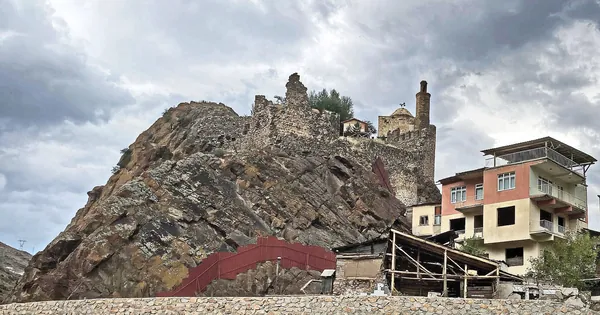
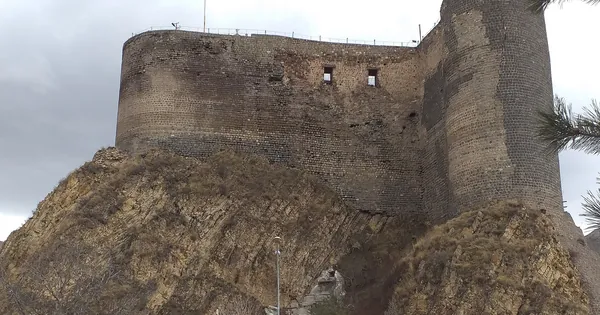
Today Oltu is known for its castle and for the black ornamental stone that bears its name. Oltu stone, mined in the villages of the area and worked into jewellery such as prayer beads, rings and earrings, holds an important place in the district's economy and identity. The castle, together with the old settlement fabric around it, remains the most important structure carrying the Saltukid, Atabeg and Ottoman layers of the region together. The old photograph in the archive shows the silhouette of the castle rising on a rocky hill amid gardens surrounded by poplars, with flat-roofed earthen houses at its foot; this image also sums up Oltu's development over the centuries as a fortress town.
Conclusion
Oltu is a Kipchak homeland, and the evidence for this is mutually reinforcing: the Georgian chronicles record that in June 1124 the Kipchaks settled in Oltu with their families; Kırzıoğlu and Özmenli show that King Demetrius settled Cumans in Ardahan, Oltu, Göle and Tortum; Kıldıroğlu records that the Kipchak Chortan tribe settled around Oltu in the Atabeg period; according to Ersin Hakan, Oltu served as the centre of the Atabeg Yurt's principality of Tao; and the TDV Encyclopaedia of Islam presents the Kipchaks around Lake Çıldır as descendants of the Kipchaks who came in the twelfth century. The Kipchaks who settled in the region on behalf of the Georgian king in 1124 formed the military and administrative cadres of the Atabeg Yurt over the following two centuries. Systematic study of the village and family names in the tahrir registers and of the local dialects will trace this Kipchak heritage village by village.
Footnotes
- “Oltu Tarihi”, Erzurum local history compilation, note text in the research archive. ↩
- M. Fahrettin Kırzıoğlu, “Yukarı Kür ve Çoruk Boyu: Atabek-Yurdu (Tarihinin Kısa Bir Özü) I”, Erzurum Dergisi, No. 9, 19 Şubat 1946, p. 10. ↩
- Kırzıoğlu, art. cit., p. 16. ↩
- Kırzıoğlu, art. cit., pp. 16-17. ↩
- İbrahim Tellioğlu, “Doğu Karadeniz Kıpçakları”, Karadeniz Araştırmaları, Sayı 48, 2015, p. 64; for an account based on Kırzıoğlu, Kars Tarihi I, İstanbul 1953, pp. 379-382, see “Kıpçakların Yayıldıkları Sahalar ve Kıpçak Dilinin Etkisi”, Türk Dünyası Araştırmaları, Sayı 140, 2002, pp. 53-64. ↩
- Mehmet Özmenli, “Ortaçağ’da Doğu Karadeniz’de Oğuz ve Kıpçak Yerleşimi”, Atatürk Üniversitesi Sosyal Bilimler Enstitüsü Dergisi, 20/2, 2016, p. 526 (citing Kırzıoğlu 1992, p. 119). ↩
- Ersin Hakan, Kars Tarihi, pp. 186-187. ↩
- Mehmet Kıldıroğlu, “Kıpçakların Çortan/Çorton/Curtan/Cordan/Yortan/Yordan Boyu Hakkında”, BELGÜ, Sayı 2, 2015, p. 128. ↩
- Mualla Uydu Yücel, “Kıpçaklar”, TDV İslâm Ansiklopedisi, c. 25, Ankara 2002, p. 420. ↩
- Treaty of Berlin, 13 July 1878, art. 58. ↩
- Treaty of Gümrü (Gyumri), 3 December 1920; Treaty of Kars, 13 October 1921. For details on the local administrations of Oltu between 1918 and 1920, see the “Oltu Tarihi” compilation, research archive. ↩
Bibliography
- “Oltu Tarihi”, Erzurum yerel tarih derlemesi (araştırma arşivindeki not metni).
- Ersin Hakan, Kars Tarihi, s. 186-187 (araştırma notlarındaki aktarım).
- Kıldıroğlu, Mehmet, “Kıpçakların Çortan/Çorton/Curtan/Cordan/Yortan/Yordan Boyu Hakkında”, BELGÜ, Sayı 2, 2015, s. 123-136.
- Kırzıoğlu, M. Fahrettin, “Yukarı Kür ve Çoruk Boyu: Atabek-Yurdu (Tarihinin Kısa Bir Özü) I”, Erzurum Dergisi, No. 9, 19 Şubat 1946, s. 9-17.
- Kırzıoğlu, M. Fahrettin, Kars Tarihi, c. I, İstanbul 1953.
- Kırzıoğlu, M. Fahrettin, Yukarı-Kür ve Çoruk Boyları’nda Kıpçaklar, Türk Tarih Kurumu Yayınları, Ankara 1992.
- “Kıpçakların Yayıldıkları Sahalar ve Kıpçak Dilinin Etkisi”, Türk Dünyası Araştırmaları, Sayı 140, Ekim 2002, s. 53-64.
- Özmenli, Mehmet, “Ortaçağ’da Doğu Karadeniz’de Oğuz ve Kıpçak Yerleşimi”, Atatürk Üniversitesi Sosyal Bilimler Enstitüsü Dergisi, 20/2, 2016, s. 515-536.
- Tellioğlu, İbrahim, “Doğu Karadeniz Kıpçakları”, Karadeniz Araştırmaları, Sayı 48, 2015, s. 59-78.
- Yücel, Mualla Uydu, “Kıpçaklar”, TDV İslâm Ansiklopedisi, c. 25, Ankara 2002, s. 420-421.
- Berlin Antlaşması (13 Temmuz 1878); Gümrü Antlaşması (3 Aralık 1920); Kars Antlaşması (13 Ekim 1921).
Mentioned in this publication
Cite this publication
Emir, E. (2026). Oltu and Its Surroundings: The History of a Kipchak Homeland. Kıpçaklar. https://kipcaktarihi.com/en/yazi/oltu-history-of-a-kipchak-homeland-erzurum
Emir, Emre. “Oltu and Its Surroundings: The History of a Kipchak Homeland.” Kıpçaklar, 2026. https://kipcaktarihi.com/en/yazi/oltu-history-of-a-kipchak-homeland-erzurum.
Emir, Emre. “Oltu and Its Surroundings: The History of a Kipchak Homeland.” Kıpçaklar, 2026, https://kipcaktarihi.com/en/yazi/oltu-history-of-a-kipchak-homeland-erzurum.
Contribute to this publication
Have you spotted an error, or do you have information or a source to add? Send an update suggestion based on your own knowledge and sources. No account is needed; suggestions are reviewed by the author and the editorial board.
Want to edit the text directly? Log in with your account and edit in the panel or create a free account. Your changes are reviewed side by side; if accepted, your name will appear among the contributors.