Political Relations between the Cuman-Kipchaks and the Rus' (1055–1120)
Translated title; original title: Kuman- Kıpçaklarla Rusların Siyasi İlişkileri (1055-1120)
An article on the political relations between the Cuman-Kipchaks and Kievan Rus' in the period 1055–1120: periods of alliance and hostility, marriage ties, and Cuman intervention in conflicts among the princes.
- Journal
- Journal of Universal History Studies, vol. 3, no. Prof. Dr. Mustafa Ke, pp. 238-251
- Year
- 2020
- Added by
- Emre Emir
- On this site
- · 1 min read
Publisher: Journal of Universal History Studies · Licence: CC BY-NC-SA 4.0 · Original record: dergipark.org.tr/tr/pub/juhis/article/800423

This text is a translation of the Turkish original. Read the Turkish original
Abstract
The abstract is shown in the original language of the publication.
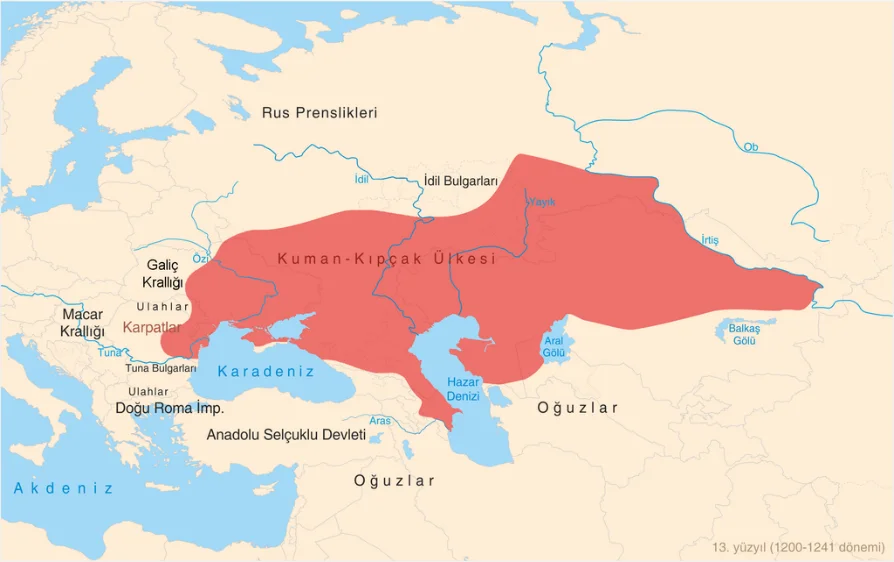
Having given a big impression on World history, Turkish tribes or states had to migrate from their mainland in Central Asia to west because of lack of climate, shrinking their greenland, various diseases and a number of political reasons. This massive migration movement on different parts of regions inevitably required to struggle with each other. Being mentioned on Russian history, Cuman-Qipchaqs had a great area from caucasia, moorland in the Black Sea, Middle Europe, Balkans to Anatolian geography. In this vast geography, Cuman-Qipchaqs interacted with some strong states during that period such as Khazar, Mongol, Georgian, Selcuks, Russian, Bulgarian, Hungarian and Byzantine Empire. From the late of thirteenth century to fifteenth century, in East European geography Cuman-Qipchaqs lived for a long time after Peçeneks. Cumans and Russia were sometimes enemy and sometimes allied forces. And they acguired big achivements over military and political area. Cuman ladies were effective to help to Kievan Rus when they had a conflict . And therefore Cumans interfered in Kievan internal affairs and they acguired a big proportion of property from Russia. The invasion of Kievan Rus to cumans caused Russia to defeat heavily against cumans. Until mongols arrived in border of East Europe, these two states remained to live between this struggle and relativity. During their period, Cuman-Qipchaqs cut Russian invasion for a long time, dominating a strategic region at the north of Black Sea and they enabled this territory to remain as Turkish land.
Editorial note
In this study Hasan Ceyhan traces the relations that the Cuman-Kipchaks established with the Rus' principalities between 1055 and 1120, after their settlement north of the Black Sea. After briefly recalling the reasons for the westward migration of the Turkic tribes from Central Asia, the author sketches a network of relations in which the two peoples were sometimes enemies and sometimes allies.
- The Cuman-Kipchaks are shown interacting with the powers of the period such as the Khazars, Georgians, Seljuks, Rus', Bulgars, Hungarians and Byzantium.
- It is emphasised that in internal conflicts among the princes of Kiev, the parties sought help from the Cumans, who were their relatives, and that Cuman noblewomen (hatun) had a marked influence on these requests.
- These invitations gave the Cumans the opportunity to interfere in Rus' internal affairs and to plunder the border regions, with grave consequences for the Rus'.
- Until the Mongols arrived in Eastern Europe, the two peoples maintained a relationship that oscillated between struggle and kinship.
- According to the author, by dominating the region north of the Black Sea, the Cuman-Kipchaks halted Rus' expansion for a long time.
Citation and access
- Published in: Journal of Universal History Studies, 3(Prof. Dr. Mustafa Keskin Special Issue), pp. 238–251 (2020)
- DOI: 10.38000/juhis.800423
- Original record: dergipark.org.tr
- Full text (PDF): on the publisher's website
- Licence: CC BY-NC-SA 4.0
This page presents the citation details of the study, the author's own abstract and our editorial board's note. For the full text, please consult the original record above; when quoting, cite the original publication.
Mentioned in this publication
Explore on the live mapCite this publication
Ceyhan, H. (2020). Political Relations between the Cuman-Kipchaks and the Rus' (1055–1120). Journal of Universal History Studies, 3(Prof. Dr. Mustafa Ke), 238-251. https://doi.org/10.38000/juhis.800423
Ceyhan, Hasan. “Political Relations between the Cuman-Kipchaks and the Rus' (1055–1120).” Journal of Universal History Studies 3, sy. Prof. Dr. Mustafa Ke (2020): 238-251. https://doi.org/10.38000/juhis.800423.
Ceyhan, Hasan. “Political Relations between the Cuman-Kipchaks and the Rus' (1055–1120).” Journal of Universal History Studies, 2020, https://doi.org/10.38000/juhis.800423.
Contribute to this publication
Have you spotted an error, or do you have information or a source to add? Send an update suggestion based on your own knowledge and sources. No account is needed; suggestions are reviewed by the author and the editorial board.
Want to edit the text directly? Log in with your account and edit in the panel or create a free account. Your changes are reviewed side by side; if accepted, your name will appear among the contributors.