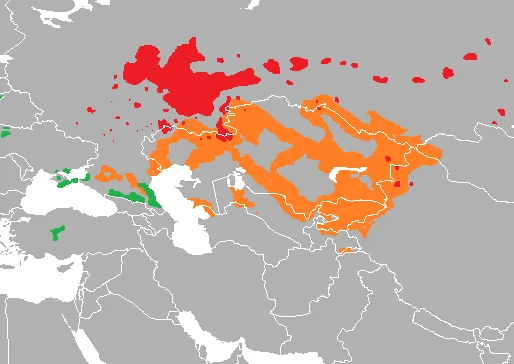
In N. A. Baskakov’s classification, Kazakh belongs to the Kipchak-Nogai subgroup together with Nogai and Karakalpak. The Kazakh people acquired a political identity with the founding of the Kazakh Khanate in the 15th century; they were formed through the union of tribes such as the Kipchak, Naiman, Kerey, Konyrat and Argyn in the eastern part of the Dasht-i Kipchak. One of the tribes of the Middle Juz still bears the name “Kipchak” today (see the Kazakh Kipchak tribe).
According to the results of the 2021 census of Kazakhstan’s Bureau of National Statistics, the country’s population was 19,186,015, and the number of Kazakhs was 13,497,891 (70.4%). In the Bureau’s estimate dated 1 January 2024, the number of Kazakhs rose to 14,220,321 (71.0%); the number of Kazakhs within the country thus exceeded 14 million for the first time.
Outside Kazakhstan there are large Kazakh communities in Russia (2021 census: about 592 thousand), China (Xinjiang; about 1.5 million according to Chinese censuses — the exact figure was not re-verified in this study), Uzbekistan and Mongolia (Bayan-Ölgii). For the Kazakhs in Turkey see “Kazakh immigrants in Turkey”.