Cultural Characteristics and Family Structure of the Kipchaks
- Book
- The Kipchak Turks — Emre Emir, 2019
- Year
- 2019
- On this site
- · 9 min read · 8 reads
This text is a translation of the Turkish original. Read the Turkish original
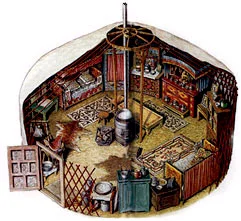
The Kipchak Turks share the same cultural characteristics as other nomadic Turks. Because, like other Turks, they led a nomadic life, the Kipchak Turks used “derme ev”, that is, houses that could be dismantled and reassembled.1 Plano Carpini, who went to this region in 1246, describing the portable houses of the Kipchaks, related that they were “woven of thin rods, had a round structure narrowing towards the top, with a hole left at the very top both to let in light and to let out smoke, that felts were wrapped around the walls of the house from the inside, and that a felt served as the door”. As this description shows, the Kipchak Turks, like their kinsmen, lived in yurts (otağ) that they set up. Likewise Ibn Battuta, who went to the Dasht-i Kipchak in 1334, recounts in his work, with extensive descriptions, that he saw such houses. In the middle of these yurts, which they set up in winter, dung was burned and food was cooked in cauldrons.2
The Rus chronicles write of the Kipchaks that on the evenings of great victories their chieftains gathered with their men and held “toy” (feasts), and that at these feasts “the minstrels (ozan), kopuz in hand, sang old and new epics of war”.3

At these feasts meat was eaten and kumis was drunk in abundance; horse meat in particular was regarded as the most valuable meat and was offered to guests.4 Like other Turks, the Kipchaks believed that after death there was a life in the other world. For this reason they buried the dead together with the belongings, horse, weapons and food they had used in life, and generally turned the heads of the graves towards the east.5
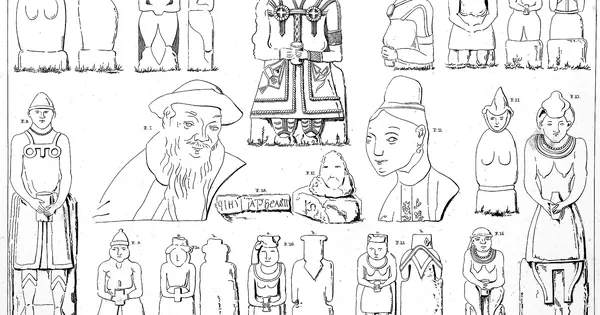
One example of the belief that life continued in the other world after death is that the Kipchaks erected “balbal” in great numbers at graves. These balbals are very varied and are generally made of stone. Separate balbals were made for men and for women. It appears that the female balbals were very beautiful, that their headscarves in particular were decorated with ornate signs, and that these were connected with the beliefs in the lives of the Cumans.
Geometric figures are also frequently found on the balbals. Besides stone, they are also seen to have drawn fine geometric patterns on bone. Thus we see that among the Kipchaks sculpture developed from early periods.6 Among the Kipchaks, who did not abandon the nomadic way of life for many years, animal husbandry came first, as among other nomadic Turks. But they used not only the meat and milk of animals but also their hides and wool. Leather, subjected to tanning, had a very wide range of uses in Kipchak society. Leather was used for everything from the making of clothing indispensable to nomadic life, such as trousers, boots, belts and börk (caps), to the production of materials such as armour, saddles, harness and quivers, and to the vessels in which drinks such as milk, ayran and kumis were kept.7
Weaving
Another craft directly related to animal husbandry, weaving, also held an important place among the Kipchaks. In Kipchak a hand weaver was called “cuhalak”, and “çekmençi” meant a cloth weaver. The çuhalak and çekmençi produced many kinds of cloth, each serving a different purpose: wool, felt, fur, cotton, velvet, linen and silk. Woven cloth was used not only for making clothes but also for producing items such as covers, sheets, swaddling cloths, cases and pouches.8
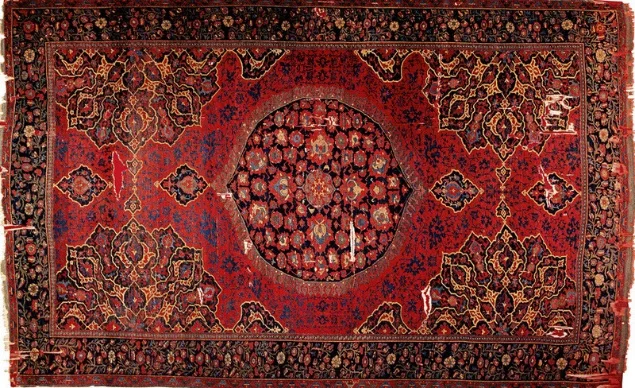
The one thing that held an important place for the nomadic Turkic peoples and that we also see in Kipchak culture is felt-making and carpet-weaving. Felt, regarded as one of the greatest skills of the Turkic peoples, is formed by trampling wool with the feet and compressing it thoroughly.9 Felt, the indispensable material of products such as the otağ (tent) above all, as well as rugs, covers, headgear and sandals, also found a place in governmental practice. Indeed, Turkic enthronement ceremonies began with the khagan being wrapped in a felt cover.10
In nomadic life the carpet was as important as felt. In the otağ, used as a home, carpets, rugs and felt covers occupied a great deal of space. Carpets, which held an important place among the nomadic Turkic peoples in general, were the chief luxury and ornament of the nomadic Turks. The Kipchaks used the words “kali” or “hali” for carpet.11
Metalwork
The archaeological material uncovered in excavations shows that among the Kipchak Turks, as among other Turks, metalwork was very important and widespread. Metalwork was the second most important source of livelihood after animal husbandry. Metal was used in many different areas, from weapon-making above all to everyday objects and accessories. The Kipchaks were highly advanced in working iron, copper, bronze and gold.12

The Kipchaks, as seen among other nomadic Turkic tribes, were a military tribe with the concept of an army-nation. Indeed, within the great Turkic nation the military qualities of the Kipchaks came to the fore more than those of other Turkic tribes.
When it comes to the military, metalwork is of great importance. Among the Kipchaks, military weapons such as arrows, bows, swords and spears were the most commonly made. We know that among the Kipchak Turks each military weapon was made by different masters.13 When the written sources and archaeological data are examined, it can readily be said that the masters producing military equipment, using their talent and skill, created products that were easy to carry, comfortable to wear and protective in defence. We can say that products that were easy to carry and comfortable to wear gave the Kipchak Turks an advantage in combat.
Another area in which the Kipchaks worked metal is accessories (jewellery and the like). Indeed, women's and men's clothing was often completed with accessories in which metal elements were used intensively. Earrings, worn not only by women but also by men, were made mostly of silver among the Kipchaks.14
However, among the material recovered from the kurgans, bronze earrings and glass, gold- and silver-plated beads have also frequently been found.15 We know from the combs made of metals such as gold and bronze found in archaeological excavations that the comb makers, called “Targakçı” among the Turkic peoples, sometimes also used metal materials.16 Archaeological excavations show that the Kipchaks were advanced in making pots and pans. The cauldrons recovered from the kurgans vary in material, being of copper, bronze and silver, and were designed in varying sizes, with or without handles.17 Besides metal vessels, earthenware vessels were also in use. The Cumans/Kipchaks also had knowledge of pottery-making.18
Woodworking
Woodworking too was among the crafts successfully practised by the Kipchaks. Items often encountered in daily life, such as saddle stands, chests and chairs, owe their existence to carpenters. Likewise tent poles, the wooden tool called “kirman” used for spinning yarn, and carpet looms all came from the hands of carpenters. In short, we can say that everything made of wood and similar materials came from the hands of carpenters.19 Among the Kipchaks, wooden statues have also been found besides stone statues. Research by Pletneva and Gurkin shows that the wooden statues, found especially densely in the lower Don region, belonged to the less wealthy section of Kipchak society.20
Family Structure among the Kipchaks

The family structure of the Kipchak Turks does not differ from that of other Turks. According to what we learn from the Orkhon Inscriptions, the social structure of the Turkic nation consisted of the Oguş (family), the Urug (relatives/lineage), the Bod (tribe), the Budun (confederation of tribes) and the İl (state).21 That the Turks preserved their existence despite being scattered to the four corners of the world stems from the great importance they gave to the family structure. If we need to identify the members of the family among the Kipchak Turks, it is possible to give the following information using Kipchak dictionaries. Among the Kipchaks the word “ata”22 was used for father, while it appears that the children of a woman by her first husband called the man their mother later married atalıh (babalık), in the sense of stepfather.23 The word ana (mother), used today, was used in exactly the same way among the Kipchaks.24 As in other Turkic tribes, among the Kipchaks a son was called "oğul",25 and a daughter "kız".26 It is well known that the same names are used today. It appears that the Kipchaks used the word "charandas"27 for sibling, "aga"28 for elder brother, and "chez charandas"29 (kız karındaş = sister) for sister. These words used among the Kipchak Turks continue to be used today, either unchanged or with small differences. As among the Old Turks, among the Kipchaks the family was represented after the father by the mother. All the material assets of the family, the home above all, were the common property of the spouses.30
Monogamy prevailed among the Kipchaks. Among the Kipchaks, as among the Old Turks, women were highly valued and there was no difference of superiority between men and women. Indeed, the fact that Kipchak women also fought alongside men is one of the best examples of this. Among the Kipchak Turks women always held a valued and respected position. Today, to study Kipchak women, it is necessary to study the tribes connected with the Kipchaks, such as the Kazakhs and the Kyrgyz. Among the Kipchak Turks there is no marriage between relatives, and marriage between relatives is not looked upon favourably. Indeed, it is possible for us to see this among the Kazakhs. That Kipchak women, like Old Turkic women, were warriors also clearly shows that there was no difference between men and women in the present-day sense. The kinship terms in the Codex Cumanicus, together with accounts, pictures and documents, show that the family structure of the Kipchak Turks was, as among the Old Turks, an equal, just and respectful family structure. Among the Kipchak Turks the family is very important, and great value was placed on their culture. Indeed, the fact that the Kipchaks living in Hungary, even though they forgot their language and adopted Christianity, kept their family culture alive and still know who they are shows this very clearly.
Footnotes
- Polnoe Sobranie Russkih Letopisi, Radzivilovskaya Letopis, c. XIII, Leningrad 1989, p. 90. ↩
- Polnoe Sobranie Russkih Letopisi, Radzivilovskaya Letopis, c. XIII, Leningrad 1989, p. 119. / İ. Parmaksızoğlu, İbni Batuta Seyahatnamesinden Seçmeler, İstanbul l981, Iı. Baskı, p. 6270. ↩
- İpatyev, pp. 429-438. ↩
- A. N. Kurat, IV. XIII. Yüzyıllarda Karadeniz Kuzeyindeki Türk Kavimleri ve Devletleri, Ankara l972, p. 104. ↩
- B. Ögel, İslamiyet’ten Önceki Türk Kültür Tarihi, Ankara l988, p. 292 ↩
- B. Ögel, İslamiyet’ten Önceki Türk Kültür Tarihi, Ankara l988, pp. 292-293 ↩
- Ali Açıkel, XI. Asırda Orta Asya Türk Boylarında Sosyal Hayat İçinde Meslek ve Sanatlar, (Marmara Üniversitesi Sosyal Bilimler Enstitüsü, Unpublished Master's Thesis), İstanbul, 1990, p. 31. ↩
- K. Grönbech, Kuman Lehçesi Sözlüğü, (Trans. Kemal Aytaç), Kültür Bakanlığı Yayınları, Ankara, 1992, pp. 46, 49, 12, 48, 53, 217. ↩
- Kaşgarlı Mahmud, Divanü Lûgatit-Türk, C. II, (Trans. Besim Atalay), Türk Dil Kurumu Yayınları, Ankara, 1998, p. 100. 18 ↩
- Bahaeddin Ögel, Türk Kültür Tarihine Giriş III, Kültür ve Turizm Bakanlığı Yayınları (2nd ed.), Ankara, 1985’a, p. 83. / Carter V. Findley, Dünya Tarihinde Türkler, (Trans. Ayşen Anadol), Kitap Yayınevi, İstanbul, 2008, pp. 57, 110. ↩
- K. Grönbech, Kuman Lehçesi Sözlüğü, (Trans. Kemal Aytaç), Kültür Bakanlığı Yayınları, Ankara, 1992, p. 87. ↩
- Abdülkadir İnan, "Türklerde Demircilik Sanatı", Makaleler ve İncelemeler II, Türk Tarih Kurumu Yayınları, Ankara, 1998 p. 229. ↩
- Suraiya Faroqhi, Osmanlı Zanaatkârları, (Trans. Zülal Kılıç), Kitap Yayınevi, İstanbul, 2011, pp. 88-89 ↩
- B. Ögel, Türk Kültür Tarihine Giriş, C. V, Kültür ve Turizm Bakanlığı Yayınları, Ankara, 1985b, p. 243.; Pletneva, Polovtsı, p. 135. ↩
- T. N. Nikolskaya, “Kurganı Verhney Volgi X-XIII vv.”, Kratkie Soobşeniya İnstituta İstorii Materialnoy Kulturı XXIII: 102-104, 1948, p. 102; E. A. Simonoviç, loc. cit. ↩
- Emel Esin, İslamiyet’ten Önceki Türk Kültür Tarihî ve İslam’a Giriş (Türk Kültürü El-Kitabı, II, Cilt I/ b’den Ayrı Basım), Edebiyat Fakültesi Matbaası, İstanbul, 1978, p. 14. ↩
- T. M. Potemkina, “Ierarhiya Polovetskoy Znati (Po Pogrebeniyam so Statusnımi Predmetami)”, Stepi Evropı v Epohu Srednevekovya 10. Donetsk-Donnu: (Yy): 7-36, 2012, pp. 288, 290, 291. ↩
- S. M. Ahincanov, Türk Halklarının Katalizör Boyu Kıpçaklar, (Trans. KürĢat Yıldırım), Selenge Yayınları, İstanbul, 2009, p. 251. ↩
- S. M. Ahincanov, Türk Halklarının Katalizör Boyu Kıpçaklar, (Trans. KürĢat Yıldırım), Selenge Yayınları, İstanbul, 2009, p. 250. ↩
- Pletneva, Polovetskie Kamennıe İzvayaniya, p. 73; S. V. Gurkin, “Polovetskie Svyatilişa s Derevyannımi İzvayaniyami Na Hijnem Donu”, Sovyetskaya Arheologiya 4, 1987, p. 100. ↩
- Mehmet Işık, Türklerin Kültür Kökenleri ve Etnik Yapısı, Yakamoz Kitap, İstanbul, 2011, p.28. ↩
- Geza Kuun, Codex Cumanicus, Budapest, 1981, p. 159. ↩
- K. Grönbech, Kuman Lehçesi Sözlüğü (Codex Cumanicus'un Türkçe Sözlük Dizini), trans.: Kemal Aytaç, Ankara, 1992, p. 15 / Geza Kuun, Codex Cumanicus, Budapest, 1981, p. 142. ↩
- Geza Kuun, Codex Cumanicus, Budapest, 1981, p. 114. / K. Grönbech, Kuman Lehçesi Sözlüğü (Codex Cumanicus'un Türkçe Sözlük Dizini), trans.: Kemal Aytaç, Ankara, 1992, p. 8 ↩
- Grönbech, Kuman Lehçesi Sözlüğü (Codex Cumanicus'un Türkçe Sözlük Dizini), trans.: Kemal Aytaç, Ankara, 1992, p. 142. ↩
- Grönbech, Kuman Lehçesi Sözlüğü (Codex Cumanicus'un Türkçe Sözlük Dizini), trans.: Kemal Aytaç, Ankara, 1992, p. 104. / Geza Kuun, Codex Cumanicus, Budapest, 1981, p. 186. ↩
- Grönbech, Kuman Lehçesi Sözlüğü (Codex Cumanicus'un Türkçe Sözlük Dizini), trans.: Kemal Aytaç, Ankara, 1992, p. 90. / Geza Kuun, Codex Cumanicus, Budapest, 1981, p. 114. ↩
- Grönbech, Kuman Lehçesi Sözlüğü (Codex Cumanicus'un Türkçe Sözlük Dizini), trans.: Kemal Aytaç, Ankara, 1992, p. 2. / Geza Kuun, Codex Cumanicus, Budapest, 1981, p. 180. ↩
- Grönbech, Kuman Lehçesi Sözlüğü (Codex Cumanicus'un Türkçe Sözlük Dizini), trans.: Kemal Aytaç, Ankara, 1992, p. 104 / Geza Kuun, Codex Cumanicus, Budapest, 1981, p. 114. ↩
- Prof. Dr. Salim. Koca, Türk Kültürü’nün Temelleri, Berkin Yayın Evi, Ankara, p.145 ↩
Mentioned in this publication
Cite this publication
Emir, E. (2019). Cultural Characteristics and Family Structure of the Kipchaks. The Kipchak Turks. Kıpçaklar. https://kipcaktarihi.com/en/yazi/kipchak-culture-and-family-structure
Emir, Emre. “Cultural Characteristics and Family Structure of the Kipchaks.” The Kipchak Turks içinde. Kıpçaklar, 2019. https://kipcaktarihi.com/en/yazi/kipchak-culture-and-family-structure.
Emir, Emre. “Cultural Characteristics and Family Structure of the Kipchaks.” Kıpçaklar, 2019, https://kipcaktarihi.com/en/yazi/kipchak-culture-and-family-structure.
Contribute to this publication
Have you spotted an error, or do you have information or a source to add? Send an update suggestion based on your own knowledge and sources. No account is needed; suggestions are reviewed by the author and the editorial board.
Want to edit the text directly? Log in with your account and edit in the panel or create a free account. Your changes are reviewed side by side; if accepted, your name will appear among the contributors.