Although the language of the Kazan (Volga) Tatars is Kipchak-based, it also carries a substratum inherited from the Volga Bulgars; for this reason Baskakov groups Tatar and Bashkir in the Kipchak-Bulgar subgroup. The share of Bulgar, Kipchak and Golden Horde-era elements in the formation of the people is debated in historiography (the “Bulgarist” and “Tatarist” approaches).
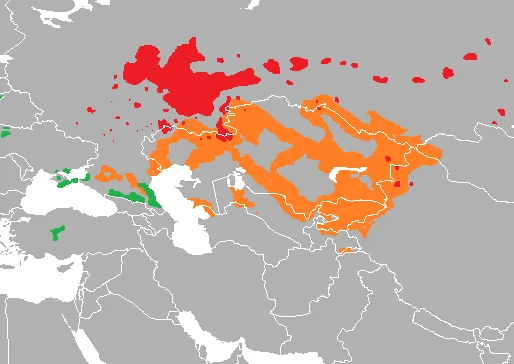
In Rosstat’s 2021 census, 4,713,669 Tatars were counted in Russia. Compared with the 2010 census (5,310,649), this shows a decline of about 600 thousand; Tatar researchers attribute a large part of this decline to the increase in 2021 of the number of people not stating their nationality to 16.6 million, and consider the results questionable. In Kazakhstan’s 2021 census, 218,653 Tatars lived there.
The map point has been placed at the centre of Tatarstan; Tatars are also numerous in Bashkortostan, Orenburg, Ulyanovsk, Chelyabinsk and Moscow.