The Migration of the Crimean Turks and Tatars to Turkey
From the Russian annexation to Soviet deportation, from the Dobruja way-station to Anatolia
The Crimean Turks and Tatars, speakers of the western branch of Kipchak Turkic, migrated in waves to Ottoman lands after 1783. The phases of the migration, the deportations and the Crimean settlements in Turkey, in the light of Müstecib Ülküsal's testimony and the historical literature.
- On this site
- · 7 min read · 6 reads
This text is a translation of the Turkish original. Read the Turkish original
Crimean Tatar belongs to the western branch of the Kipchak group of the Turkic languages, and from the thirteenth century the Crimean peninsula was the gateway of the Dasht-i Kipchak to the Black Sea. The annexation by Russia in 1783 of the Crimean Khanate, which had emerged from the Golden Horde, marked the beginning of a period of migration lasting nearly two centuries for the peninsula's Muslim Turkic population. The chief destination of this migration was the Ottoman state and its successor, the Republic of Turkey. The work of Müstecib Ülküsal, one of the leading figures of the Crimean Turkic-Tatar national movement, published in 1980, offers both a testimony and a nationalist interpretation of this process.1
Ülküsal's own life is also part of this history of migration. Raised within the Crimean emigrant community of Dobruja, the author held positions in Crimean Turkic-Tatar associations and publications in Romania, and after the Second World War he settled in Turkey and became one of the leaders of the Crimean cause there. His work is therefore valuable as a testimony written from within the events; for the same reason it requires careful reading where figures and assessments are concerned. Below, the information Ülküsal provides will be assessed together with academic studies on the history of the migration.
From the annexation to the Crimean War: the first great waves
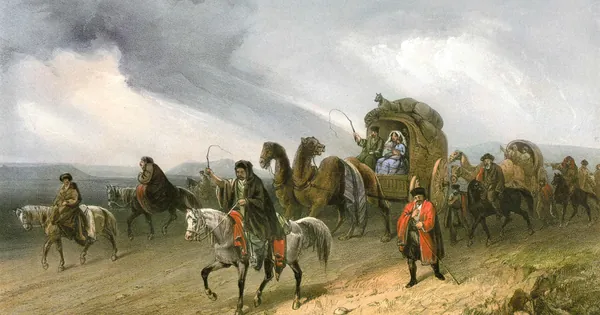
Immediately after the annexation of 1783, pressures on land and religion drove many of the Crimean nobles and peasants towards Ottoman territory. The real mass migration, however, came after the Crimean War of 1853–1856. Increased pressure, justified on the grounds that the Tatars had shown sympathy for the Ottomans and their allies during the war, led to a great exodus from the peninsula in 1860–1862. Estimates of the number of emigrants in this wave vary from tens of thousands to figures exceeding two hundred thousand.2 Ülküsal emphasises that the Crimean Turks and Tatars began to migrate to Rumelia and Anatolia within Ottoman territory especially after 1878.3 The introduction of compulsory military service in the Russian army in the 1870s and land problems in the 1890s and early 1900s also triggered new waves.
The Dobruja way-station
While some of the emigrants went directly to Istanbul and Anatolia, a large proportion settled in Dobruja and the Balkans, which remained Ottoman territory until the Russo-Ottoman War of 1877–1878 (the “93 War”). Landing by sea at the ports of Constanța, Mangalia, Kavarna, Balchik, Varna and Burgas, the Crimeans settled in old villages in northern and southern Dobruja and founded new ones.4
After 1878, however, when Northern Dobruja passed to Romania and Southern Dobruja to Bulgaria, these communities were forced to migrate a second time. Ülküsal writes that for economic and religious reasons and because of the obligation of military service the Turks migrated to Turkey “ceaselessly”, and that there were many migrations, especially after the emigration agreement concluded between Turkey and Romania, up to the Second World War. Ülküsal dates this agreement to 1934; the Turkish-Romanian convention on the migration of the Dobruja Turks, however, is generally cited with the date 4 September 1936. Ülküsal emphasises that people of Crimean origin, including those who came from Dobruja, embraced Turkey as their “rightful land” and “second homeland”.5
Famine and deportation in the Soviet period
Soviet rule also opened a harsh period for those who remained in Crimea. According to Ülküsal, in 1929–1930, 35,000 Crimean Turks and Tatars who owned land and farms were deported to the Urals and to labour camps in Siberia, on the assumption that they would oppose collectivisation; during the famine of 1931–1933, while the streets filled with people dying of hunger, wheat was being loaded onto foreign ships in the Crimean ports.6 In describing this period, Ülküsal quotes from an article by the British journalist Gareth Jones about his journey through the Soviet Union: a Tatar girl of about eight, selling flowers in the streets of Moscow, said that she had fled Crimea with her mother and that there was “no bread left at all” there.7
The greatest catastrophe of the Crimean Tatars, however, was the mass deportation that began on 18 May 1944. On the baseless charge of “collective collaboration” during the German occupation, the Soviet government deported the entire Crimean Tatar people within a few days to Central Asia, mainly to Uzbekistan. The number of deportees in Soviet records is around 190,000; the proportion of those who died on the way and in the first years is given as 18–20 per cent in Soviet documents and over 40 per cent in Crimean Tatar sources.8 After this date direct migration from Crimea to Turkey became virtually impossible.
What Ülküsal describes for the 1930s is in fact a set of links in a longer chain of disasters. The famine that struck Crimea in 1921–1922 had also severely affected the peninsula's Tatar population, and the repression that began in the first years of Soviet rule had resulted in the elimination of a large part of the Crimean Tatar intelligentsia. The 1944 deportation is therefore regarded not as an isolated event but as the last and greatest link in a destruction lasting more than twenty years. The traces of the deportation also hold a deep place in the collective memory of the Crimeans in Turkey; the commemorations held every year on 18 May are the most visible example of this.
A small wave after the Second World War
According to Ülküsal, the number of Crimeans who left the peninsula with the German troops during the war and went to Western Europe was about 10,000. Some 6,000 of them settled in the United States and some 4,000 in Turkey.9 This group that came to Turkey played an important role, thanks to the intellectuals among them, in the revival of Crimean Turkic-Tatar associations and publications.
Crimeans in Turkey: settlement and the debate over numbers
From the nineteenth century onward the emigrants were settled over a wide area, above all in Eskişehir, Ankara (especially around Polatlı), Konya, Bursa, Kastamonu, Merzifon, Adapazarı and Istanbul; many villages bear the names of villages in Crimea.10 Ülküsal writes that “some five and a half million” Turks of Crimean origin live in the cities, towns and villages of Turkey, and that after Crimea came under Russian rule Turkey became the country where Crimeans live in the greatest numbers.11
Turkey is the largest diaspora centre of the Crimeans. Since population censuses in Turkey do not ask about ethnic origin, the figure of five and a half million rests not on a census but on an estimate; it includes all descendants of emigrants, those born of mixed marriages and those who do not identify themselves as Crimean. This estimate shows how large a population of Crimean origin two centuries of migration waves have created in Turkey.
The settlement pattern of the emigrants is also noteworthy. The Ottoman administration mostly settled the Crimeans on vacant state land, on the steppe-like plateaus of Central Anatolia and along the railway lines. The villages between Eskişehir and Ankara are examples of this choice. Hakan Kırımlı's village-by-village identifications show that many settlements bear the names of villages in Crimea and that the emigrants re-established their village and family ties in their new homeland. In these villages Crimean Tatar survived as an everyday language until the mid-twentieth century; today it lives on mostly among the older generations and in the activities of cultural associations. The ability of the Crimean Tatars to return to the peninsula from Central Asia, where they had been deported, after 1989 also revived the ties between the Crimeans in Turkey and the ancestral homeland.
Conclusion
The migration of the Crimean Turks and Tatars to Turkey is a long process that began with the annexation of 1783 and continued with the great wave after the Crimean War, the 93 War, the second migration from Dobruja and a small group after the Second World War. Müstecib Ülküsal's work is a valuable testimony and a rich source of data for this process; but figures such as the 35,000 deportees or five and a half million people of Crimean origin should be used only after comparison with independent sources. Today the çibörek, Crimean folk songs and the Crimean Tatar language that live on in the villages stretching from Eskişehir to Polatlı are among the most vibrant legacies of the Dasht-i Kipchak in Anatolia.
Footnotes
- Müstecib Ülküsal, Kırım Türk-Tatarları (Dünü, Bugünü, Yarını), Baha Matbaası, İstanbul 1980. ↩
- Kemal H. Karpat, Ottoman Population 1830-1914: Demographic and Social Characteristics, University of Wisconsin Press, Madison 1985; Brian Glyn Williams, The Crimean Tatars: The Diaspora Experience and the Forging of a Nation, Brill, Leiden 2001. ↩
- Ülküsal, op. cit., p. 273. ↩
- Ülküsal, op. cit., pp. 142-143. ↩
- Ülküsal, op. cit., pp. 143-144. ↩
- Ülküsal, op. cit., pp. 249-250. The number of deportees is an estimate that has not been compared with other sources. ↩
- Ülküsal, op. cit., p. 251. Ülküsal quotes the article from the Morning Post; Gareth Jones was foreign affairs adviser to the former British prime minister Lloyd George. ↩
- Williams, The Crimean Tatars, 2001; for differing estimates of the death rates, see the chapter on the deportation in the same work. ↩
- Ülküsal, op. cit., pp. 348-349. ↩
- Hakan Kırımlı, Türkiye’deki Kırım Tatar ve Nogay Köy Yerleşimleri, Tarih Vakfı Yurt Yayınları, İstanbul 2012. ↩
- Ülküsal, op. cit., pp. 348 and 350. ↩
Bibliography
- Karpat, Kemal H., Ottoman Population 1830-1914: Demographic and Social Characteristics, University of Wisconsin Press, Madison 1985.
- Kırımlı, Hakan, Türkiye’deki Kırım Tatar ve Nogay Köy Yerleşimleri, Tarih Vakfı Yurt Yayınları, İstanbul 2012.
- Ülküsal, Müstecib, Kırım Türk-Tatarları (Dünü, Bugünü, Yarını), Baha Matbaası, İstanbul 1980.
- Williams, Brian Glyn, The Crimean Tatars: The Diaspora Experience and the Forging of a Nation, Brill, Leiden 2001.
Mentioned in this publication
Cite this publication
Emir, E. (2026). The Migration of the Crimean Turks and Tatars to Turkey. Kıpçaklar. https://kipcaktarihi.com/en/yazi/crimean-tatar-migration-to-turkey-annexation-to-deportation
Emir, Emre. “The Migration of the Crimean Turks and Tatars to Turkey.” Kıpçaklar, 2026. https://kipcaktarihi.com/en/yazi/crimean-tatar-migration-to-turkey-annexation-to-deportation.
Emir, Emre. “The Migration of the Crimean Turks and Tatars to Turkey.” Kıpçaklar, 2026, https://kipcaktarihi.com/en/yazi/crimean-tatar-migration-to-turkey-annexation-to-deportation.
Contribute to this publication
Have you spotted an error, or do you have information or a source to add? Send an update suggestion based on your own knowledge and sources. No account is needed; suggestions are reviewed by the author and the editorial board.
Want to edit the text directly? Log in with your account and edit in the panel or create a free account. Your changes are reviewed side by side; if accepted, your name will appear among the contributors.